 더 읽기
더 읽기
핵심 요약
- Spain’s Beckham Law allows eligible expats to be taxed under non-resident rules while living in Spain.
- Fixed tax rate of 24% applies to income up to €600,000.
- Standard Spanish income tax rates can exceed 50%, making the regime highly attractive for high earners.
- Foreign-source income is generally not taxed in Spain under the regime.
- Participants are typically exempt from worldwide wealth tax exposure.
- No obligation to file Modelo 720 for foreign assets in many cases.
- The non-residency requirement was reduced from 10 years to 5 years.
- Digital nomads, remote workers, entrepreneurs, and startup founders are now eligible.
- Spain’s Digital Nomad Visa can often be combined with the Beckham Law benefits.
- The regime can generate annual tax savings ranging from €10,000 to €30,000+ depending on income.
- Spanish tax authorities actively monitor abuse and fake employment structures.
- Proper tax planning before relocation is essential to maintain eligibility and maximize savings.
이 기사에서
Moving to Spain in 2026 could do more than upgrade your lifestyle — it could dramatically reduce your tax bill.
Spain’s famous “Beckham Law” remains one of the most attractive tax regimes in Europe for international professionals, entrepreneurs, digital nomads, and remote workers. Under this special tax system, eligible newcomers can pay a flat 24% income tax rate instead of Spain’s progressive rates that can exceed 50% in some regions.
For high earners and globally mobile professionals, the savings can be substantial.
What Is the Beckham Law in Spain?
The “Beckham Law” is the informal name for Spain’s special expatriate tax regime, regulated under Article 93 of the Spanish Personal Income Tax Act (IRPF).
It allows qualifying individuals who relocate to Spain to be taxed under the non-resident tax system (IRNR) while still being considered Spanish tax residents.
The key advantage?
You are generally taxed only on Spanish-source income.
Tax rates under the regime:
- 24% on employment income up to €600,000
- 47% on income above that threshold
By comparison, standard Spanish income tax rates can reach approximately 50–54%, depending on the autonomous region.
Why Is It Called the “Beckham Law”?
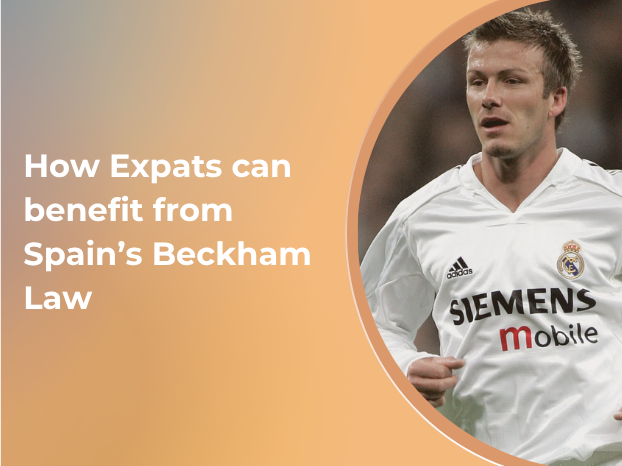
The nickname comes from football star David Beckham, who moved to Spain in 2005 to play for Real Madrid and became one of the most famous beneficiaries of the regime.
Although the official name is simply the “special tax regime for inbound workers,” the media quickly popularized the term “Beckham Law.”
Interestingly, professional athletes are no longer eligible under the current version of the regime.
What Changed in 2026?
The regime became significantly more flexible after Spain’s Startup Law reforms.
Expanded eligibility
Spain now allows more categories of professionals to apply, including:
- Digital nomads
- Remote employees
- Entrepreneurs
- Startup founders
- Highly qualified specialists
Reduced non-residency requirement
Previously, applicants could not have been Spanish tax residents for 10 years.
Now, the requirement is only 5 years, making the regime much more accessible — especially for Spaniards returning from abroad.
Digital Nomads and Remote Workers
Spain has positioned itself as one of Europe’s leading destinations for remote workers.
Under the updated rules, digital nomads relocating to Spain may combine:
- the Digital Nomad Visa
- with the Beckham Law tax regime
This creates a highly competitive setup compared with other European countries.
Eligible remote workers may benefit from:
- residency permits of up to 5 years
- simplified immigration procedures
- a flat 24% tax rate
Main Requirements to Qualify
To access the Beckham Law regime in 2026, applicants generally must:
✔ Not have been a Spanish tax resident during the previous 5 years
✔ Move to Spain for work, business activity, or entrepreneurial reasons
✔ Perform qualifying professional activity in Spain
✔ Avoid creating a permanent establishment in Spain (in many cases)
Because eligibility can depend heavily on your corporate structure and income sources, professional tax advice is strongly recommended.
The Biggest Tax Advantages
1. Flat 24% Tax Rate
For many high-income professionals, this is the primary benefit.
Example
Annual salary: €150,000
- Under Beckham Law: approximately €36,000 tax
- Under standard Spanish taxation: approximately €52,500 tax
Estimated annual savings:
~€16,500
2. Foreign Income Exemption
In many situations, foreign-source income is not taxed in Spain under this regime.
This may include:
- foreign dividends
- overseas investments
- non-Spanish interest income
- certain capital gains
For internationally diversified individuals, this can create enormous tax efficiencies.
3. No Worldwide Wealth Tax Exposure
Spain has wealth tax rules that can apply to global assets.
However, Beckham Law participants are generally taxed only on Spanish assets, potentially avoiding taxation on overseas wealth.
4. No Modelo 720 Filing
Standard Spanish tax residents often must file Modelo 720, the controversial declaration of foreign assets.
Beckham Law beneficiaries are generally exempt from this reporting obligation.
Real-World Example
A German executive relocates to Madrid in 2026:
- Salary: €120,000
- Foreign dividends: €15,000
- Spanish rental income: €18,000
Taxable income in Spain:
€138,000
Estimated tax under Beckham Law:
€33,120
Estimated savings versus ordinary taxation:
Approximately €15,000 annually
Risks and Common Mistakes
The Spanish tax authorities have increased scrutiny in recent years.
Fake employment structures
Authorities actively investigate:
- artificial contracts
- shell companies
- non-genuine employment relationships
Improper use of the regime can result in:
- heavy penalties
- retroactive tax reassessments
- loss of tax benefits
Losing the Regime
You may lose eligibility if:
- you switch into certain self-employed structures
- your activity creates a permanent establishment
- you no longer meet residency conditions
Careful tax planning is essential before restructuring your business or freelance activity.
How Spain Compares to Other European Tax Regimes
Portugal - Portugal’s well-known NHR regime was effectively phased out in 2024.
- Portugal - Their well-known NHR regime was effectively phased out in 2024.
- Italy - They still offers attractive inbound tax incentives, including partial exemptions on employment income.
- Netherlands - The Dutch “30% ruling” remains popular but has become more restrictive.
- Spain currently offers one of the most competitive combinations of lifestyle, residency access, climate, international connectivity, tax efficiency, and for globally mobile professionals.
Frequently Asked Questions
Can Spanish citizens use the Beckham Law?
Yes — if they have not been Spanish tax residents during the previous 5 years.
How much can you realistically save?
Approximate examples:
- €100,000 income → savings of €12k–15k/year
- €200,000+ income → savings of €30k+/year
What happens if income exceeds €600,000?
- First €600k taxed at 24%
- Excess taxed at 47%
The regime still applies.
Do frequent trips outside Spain affect the regime?
Usually no.
You generally must remain a Spanish tax resident, which normally means:
- spending more than 183 days per year in Spain, or
- maintaining your center of economic interests there
Conclusion
For international professionals considering a move to Europe, Spain’s Beckham Law remains one of the most powerful legal tax optimization tools available in 2026.
Combined with Spain’s lifestyle, growing startup ecosystem, and digital nomad infrastructure, the regime can offer substantial long-term financial advantages.
However, the rules are technical and highly situation-dependent. Before relocating, it is essential to structure your move correctly from both a tax and immigration perspective.
If you are considering relocating to Spain and want to estimate your potential tax savings, professional planning before the move can make a significant difference. Contact us today!